
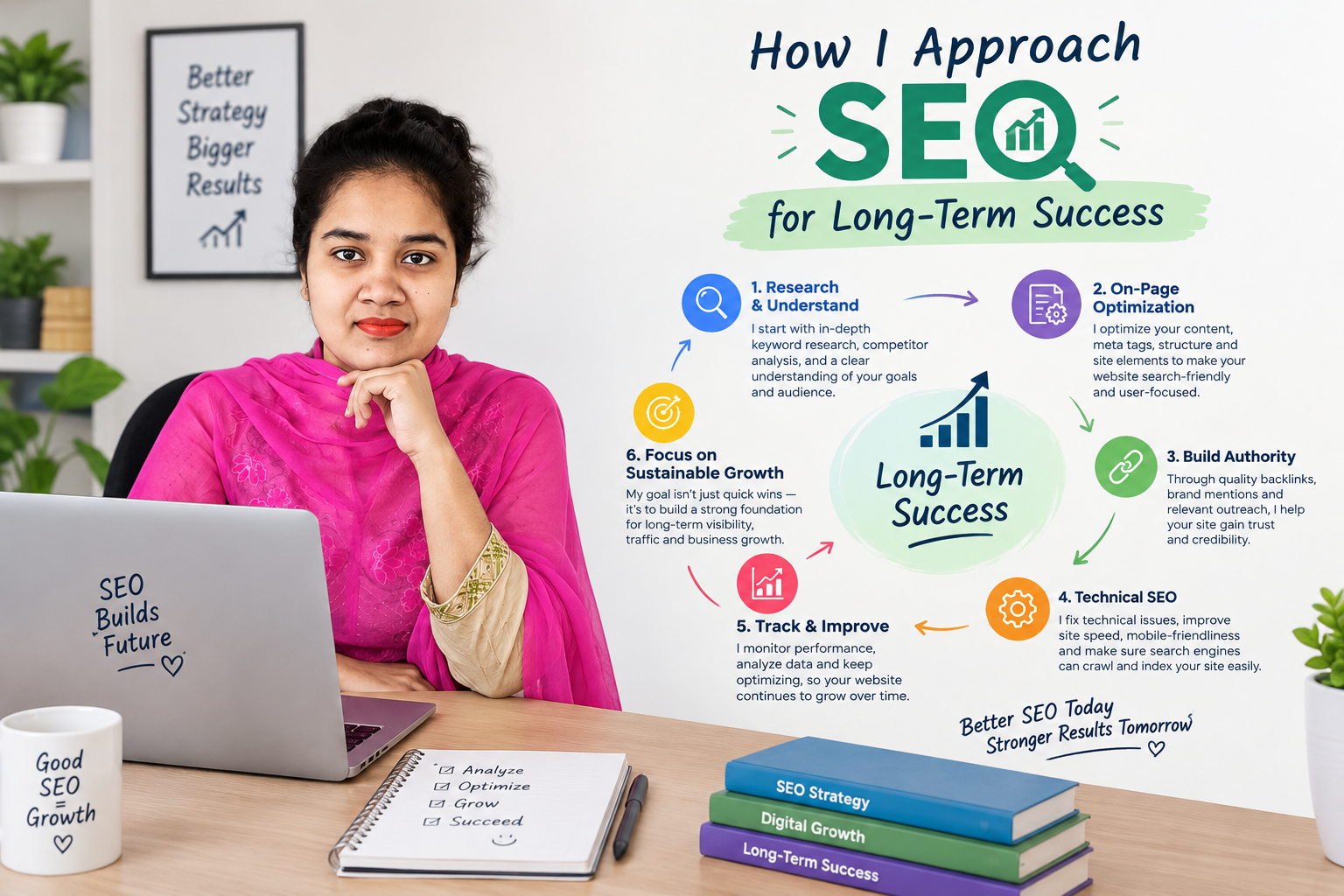
How I Approach SEO for Long-Term Success
SEO is not something I see as a quick ranking trick. For me, SEO is a long-term growth strategy that connects a business with the people who are actively searching for its products, services, information, or solutions. My name is Sumiya Fariha, and as an SEO expert in Bangladesh, my approach is focused on building sustainable visibility rather than chasing temporary rankings. Search engines continue to evolve, and Google's Search Central documentation is regularly updated as search experiences, technical guidance, and search features change. That’s why I focus on more than keywords when working on SEO. It requires understanding the business, researching the audience, creating useful content, improving the technical foundation, building credibility, and measuring what actually works. When I work on SEO, I think about the website as a long-term asset. A page should not simply rank today; it should continue to provide value tomorrow. My goal is to create an SEO strategy that can grow with a business, adapt to changes in search, and build genuine trust with users.
My SEO Philosophy: Build for People First
My first SEO principle is simple: optimize for people before search engines. A website can have perfectly placed keywords and still fail if visitors cannot find what they need, do not trust the information, or leave because the content does not answer their questions. I therefore start by asking what a real visitor expects when they land on a page. Google's current search documentation continues to emphasize useful search experiences and provides guidance around how websites can influence their appearance in Search. I do not treat SEO as a numbers game where the highest keyword density wins. Instead, I look at SEO like building a bridge: one side represents the business, while the other represents the searcher. Good SEO connects both sides naturally.
Why Long-Term SEO Matters
Short-term SEO tactics can sometimes create temporary movement, but sustainable SEO requires a broader perspective. Search visibility can change when competitors publish better content, technical problems appear, user needs change, or search engines introduce new features. Google has also continued updating its documentation and search ecosystem in 2026, including changes and additions related to search appearance, regional experiences, and site reputation. This is why I avoid building a strategy around one ranking position or one keyword. Instead, I focus on creating a stronger website overall. That means improving multiple pages, targeting relevant search intent, strengthening topical relevance, resolving technical issues, and building credibility over time. Long-term SEO is similar to planting a tree. You do not plant it today and expect a fully grown tree tomorrow. You provide the right foundation, continue caring for it, monitor its growth, and make adjustments when necessary. The same mindset applies to SEO. Consistency, patience, analysis, and continuous improvement are what turn SEO from a one-time task into a sustainable marketing channel.
Before making SEO changes, I believe in understanding the bigger picture. I want to know what the business offers, who its customers are, which locations it serves, what makes it different, and what actions it wants visitors to take. A local service provider may need a different SEO strategy from an international e-commerce business, even if both websites sell similar products. I also look at the website's existing structure, content quality, technical condition, competitors, and current search visibility. From there, I identify opportunities and prioritize them according to business impact. This helps prevent a common SEO problem: doing dozens of small tasks without knowing which ones actually matter. A well defined strategy ensures that every activity is purpose driven and aligned with the broader objectives . If keyword research identifies an important topic, I ask whether the website has a suitable page for it. If a technical audit discovers an issue, I consider whether fixing it could improve crawling, usability, or search accessibility. If competitors are gaining visibility, I study what they are doing well rather than simply copying them. Strategy comes first; execution follows.
Understanding the Business and Audience
SEO becomes much stronger when it is connected to the real customer journey. I therefore try to understand the language customers use, the questions they ask, their concerns, and the reasons they choose one business over another. Search queries can reveal a lot about this journey. Someone searching for a basic definition may still be researching, while someone searching for a specific service may already be close to taking action. These users should not necessarily receive the same content. My approach is to map keywords and topics to different stages of the customer journey. I also consider location when it matters, especially for businesses targeting customers in Bangladesh or specific cities. This allows me to create content that feels relevant instead of generic. For me, good SEO begins with empathy. If I understand what the audience wants, I can create pages that answer real questions and guide users naturally toward the next step.
I believe SEO goals should be connected to business outcomes rather than vanity metrics alone. Rankings can be useful indicators, but ranking number one for an irrelevant keyword does not necessarily create business growth. I prefer to consider a wider group of signals, including relevant organic traffic, qualified visitors, impressions, clicks, conversions, engagement, and visibility across important topics. The exact goals depend on the website. A service business may care about consultation requests, while an e-commerce website may focus on product visibility and purchases. A blog may prioritize qualified organic traffic and returning readers. By defining the goal first, I can decide which SEO activities deserve the most attention. I also set realistic expectations because SEO normally requires time and repeated improvement. I would rather build steady growth than promise unrealistic results in a few weeks. Honest communication is part of my SEO approach because trust should exist between the SEO professional and the business owner just as much as it should exist between the website and its audience.
My Approach to Keyword Research
Keyword research is one of the foundations of my SEO process, but I do not treat it as simply finding keywords with high search volume. I look for relevance, intent, competition, business value, and context. A keyword might have thousands of searches but be almost useless for a particular business. Another keyword might have lower search volume but bring highly qualified visitors who are much more likely to become customers. I therefore examine what users actually expect when they search a phrase. I group related terms and topics instead of creating a separate page for every tiny keyword variation. This helps create more comprehensive resources and reduces unnecessary duplication. I also pay attention to long-tail keywords because they can reveal specific problems, questions, and purchase intentions. My goal is to build a keyword map that supports the overall website architecture. Each important page should have a clear purpose, and the target keyword should naturally fit that purpose rather than being forced into the content.
Search intent is at the center of my keyword strategy. I generally consider whether a searcher wants to learn something, find a particular website, compare options, or take an action. The wording of a query often provides clues about what type of page would be useful. For example, informational searches may need detailed educational content, while service-focused searches may need a clear service page explaining benefits, process, expertise, and next steps. Matching content to intent makes SEO more useful for both searchers and businesses. I also examine the existing search results to understand the type of content users are being shown. If most results are guides, creating a thin promotional page may not satisfy the search intent. If results are primarily service pages, an overly broad article may not be the best fit. This research helps me decide what content format, depth, structure, and angle are appropriate.
Creating Helpful and Trustworthy Content
Content is one of the most important parts of a sustainable SEO strategy. I want every important page to have a clear reason for existing and provide something useful to the reader. That means avoiding unnecessary repetition, vague statements, and content created only to attract search traffic. I focus on clear explanations, relevant examples, practical information, and a natural writing style. I also believe content should reflect the business's actual knowledge and experience. When appropriate, first-hand observations, processes, examples, case studies, author information, and genuine expertise can make content more useful and credible. Google's current guidance also provides specific best practices for author markup, including clearly identifying authors and using appropriate author information such as an author URL or sameAs where applicable. For me, this fits naturally into an E-E-A-T mindset: readers should be able to understand who created the information and why that person or organization is qualified to discuss the topic.
I use Experience, Expertise, Authoritativeness, and Trust as a practical framework for improving content quality. Experience asks whether the content demonstrates genuine involvement with the subject. Expertise asks whether the information is accurate, useful, and knowledgeable. Authoritativeness relates to the credibility of the creator and website, while trust focuses on accuracy, transparency, safety, and reliability. E-E-A-T should not be treated like a checkbox where adding a short author bio magically makes a page trustworthy. Instead, it should influence how content is researched, written, reviewed, presented, and maintained. For my own work as an SEO expert in Bangladesh, I want my content to clearly communicate what I know, how I approach SEO, and what readers can realistically expect. I also avoid making unsupported guarantees. Search performance depends on many factors, so responsible SEO communication should explain possibilities rather than promise guaranteed rankings. Trust is earned through consistency, transparency, useful work, and evidence—not through exaggerated claims.
Building a Strong On-Page SEO Foundation
On-page SEO is the process on which a website visibility fully depends . I work on elements such as title tags, headings, content structure, URLs, internal links, image optimization, keyword placement, and user-focused copy. I do not force keywords into every sentence because unnatural optimization can make content harder to read. Instead, I use the primary topic naturally and support it with related concepts that help explain the subject thoroughly. Internal linking is also important because it helps users discover related information and gives search engines useful context about the relationships between pages. I think of a website as a library: individual pages are the books, while internal links are the shelves and pathways that help visitors move between related subjects. A well-organized website makes it easier for people to understand what the business offers and where to find additional information. I also review heading structures to make sure they communicate the page's hierarchy rather than simply being containers for keywords.
Optimizing Titles, Headings, Links, and Content
A good title should communicate what the page is about without becoming a list of keywords. Headings should guide readers through the subject, while paragraphs should answer questions clearly and naturally. Internal links should point to genuinely relevant pages rather than being added simply to increase link counts. I also consider whether important information is easy to find without unnecessary scrolling or confusion. Images should support the content and have descriptive alternative text when appropriate. Structured data can also help search engines understand certain types of content; Google's documentation explains that structured data provides information that can help Google understand page content and potentially support richer search appearances. However, I never treat structured data as a guarantee of enhanced search results. It is one part of a broader optimization process. My goal is always to make the page useful first, then make its important signals clear to search engines.
Technical SEO for Sustainable Growth
Technical SEO is another major part of my long-term approach. A website can have excellent content and still struggle if search engines cannot properly crawl, render, or index important pages. I therefore consider areas such as crawlability, indexability, XML sitemaps, robots.txt, canonical tags, redirects, broken links, mobile usability, page performance, and site architecture. Good technical SEO often makes a website simpler and easier to understand. I also pay attention to how pages connect with one another and whether important content can be reached through sensible crawl paths. When websites undergo migrations or URL changes, I take redirects and URL mapping seriously because poor migration planning can cause avoidable visibility problems. Google currently recommends preparing URL mappings and configuring redirects when changing existing URLs as part of a site move. This illustrates why technical SEO should be considered before major changes rather than treated as an emergency fix afterward.
Improving Crawling, Indexing, and Website Performance
My technical SEO process focuses on removing barriers between valuable content and search engines. I check whether important pages are accessible, whether unwanted pages are creating confusion, and whether canonical signals are appropriate. XML sitemaps can help communicate important URLs, while robots.txt can control crawler access to specific resources, although these tools should be used correctly and for their intended purposes. I also consider website performance because users expect pages to work smoothly across devices. Mobile optimization, responsive design, stable layouts, and fast interactions all contribute to a better experience. I use technical data and available SEO tools to identify problems, but I always connect the technical issue to its practical impact. A report showing an error is only the beginning. The important question is what the error means for users, crawling, indexing, or conversions and what should be prioritized first. This prevents technical SEO from becoming a never-ending list of tasks without business context.
Using Competitor SEO Analysis Strategically
Competitor analysis helps me understand the search landscape before making major decisions. I look at which topics competitors cover, how they structure their pages, what keywords appear important, where they have strong visibility, and where there may be gaps. However, I do not believe the right strategy is to copy a competitor page and change a few words. That creates a race where everyone produces the same content. Instead, I use competitor analysis to discover opportunities. Perhaps competitors answer the main question but ignore a common follow-up question. Perhaps their service pages are difficult to navigate. Perhaps their content is detailed but lacks practical examples. These gaps can become opportunities to create something more useful. I also compare website structures and internal linking patterns where relevant. The goal is not to imitate competitors; it is to understand the market and find ways to offer a stronger experience. A competitor can show me where the road is crowded, but it does not determine the route my strategy has to take.
Off-page SEO is another area where I prefer quality over shortcuts. I focus on building genuine authority through relevant relationships, useful resources, digital PR opportunities, legitimate mentions, citations, and other activities that make sense for the business. I avoid strategies based on manipulating links or creating large numbers of low-quality backlinks simply to increase a metric. Search engines continue to maintain spam policies addressing manipulative practices, including problematic third-party content and other methods intended to exploit ranking signals. This reinforces my belief that sustainable authority should be earned rather than manufactured. A relevant mention from a trusted source can be more meaningful than dozens of unrelated links. Ultimately, off-page SEO should answer one question: Why should other people and websites trust this business? If the answer is supported by real expertise, useful resources, strong service, and genuine relationships, authority becomes much more sustainable.
Measuring SEO Performance and Improving Continuously
I do not consider an SEO campaign finished when a page reaches a target position. Search behavior changes, competitors improve, websites change, and search results evolve. That means SEO needs continuous measurement and refinement. I review performance using relevant metrics such as impressions, clicks, rankings, organic traffic, conversions, and page-level performance. I also look for patterns rather than reacting emotionally to every small ranking fluctuation. If traffic increases without conversions, the problem may be related to intent, landing-page experience, offer clarity, or audience quality rather than rankings alone. If a page loses visibility, I investigate before changing everything. Google's current documentation also emphasizes using Search Console and other tools to monitor how content performs and how Google accesses pages. This analytical mindset helps me turn SEO into a continuous improvement process rather than a one-time campaign.
My Long-Term SEO Mindset
My long-term SEO mindset can be summarized in one idea: build something that deserves to rank. I do not want a website to depend on temporary tricks, keyword stuffing, or unrealistic promises. I want its content to be genuinely useful, its technical foundation to be healthy, its structure to be logical, and its reputation to grow naturally. As an SEO expert in Bangladesh, I understand that different businesses have different resources, audiences, competitors, and growth goals. Therefore, I adapt the strategy instead of forcing every client into the same template. I combine research, technical SEO, on-page optimization, content strategy, competitor analysis, and ethical off-page SEO into a process that can evolve over time. Search itself is changing, including the way users encounter information through newer search experiences and AI-related features. Google's 2026 documentation updates show that search appearance and search experiences continue to develop. My job is not to predict every future change perfectly. My job is to build websites and strategies that are strong enough to adapt.
How I approach SEO for long-term success is ultimately about creating sustainable value. I begin with the business and audience, research search intent, build a clear keyword strategy, create helpful content, strengthen on-page elements, improve technical SEO, analyze competitors, build authority ethically, and measure performance continuously. My goal is not simply to make a website appear in search results; it is to help that website become a useful and trustworthy destination for its target audience. SEO takes patience because meaningful growth rarely happens overnight. But when the strategy is built around real user needs, strong technical foundations, credible content, and continuous improvement, SEO can become one of the most valuable long-term marketing investments a business can make. As Sumiya Fariha, an SEO expert in Bangladesh, my approach is to focus on sustainable growth rather than short-lived ranking tricks. I believe the strongest SEO strategy is one that keeps working because the website itself keeps getting better.