
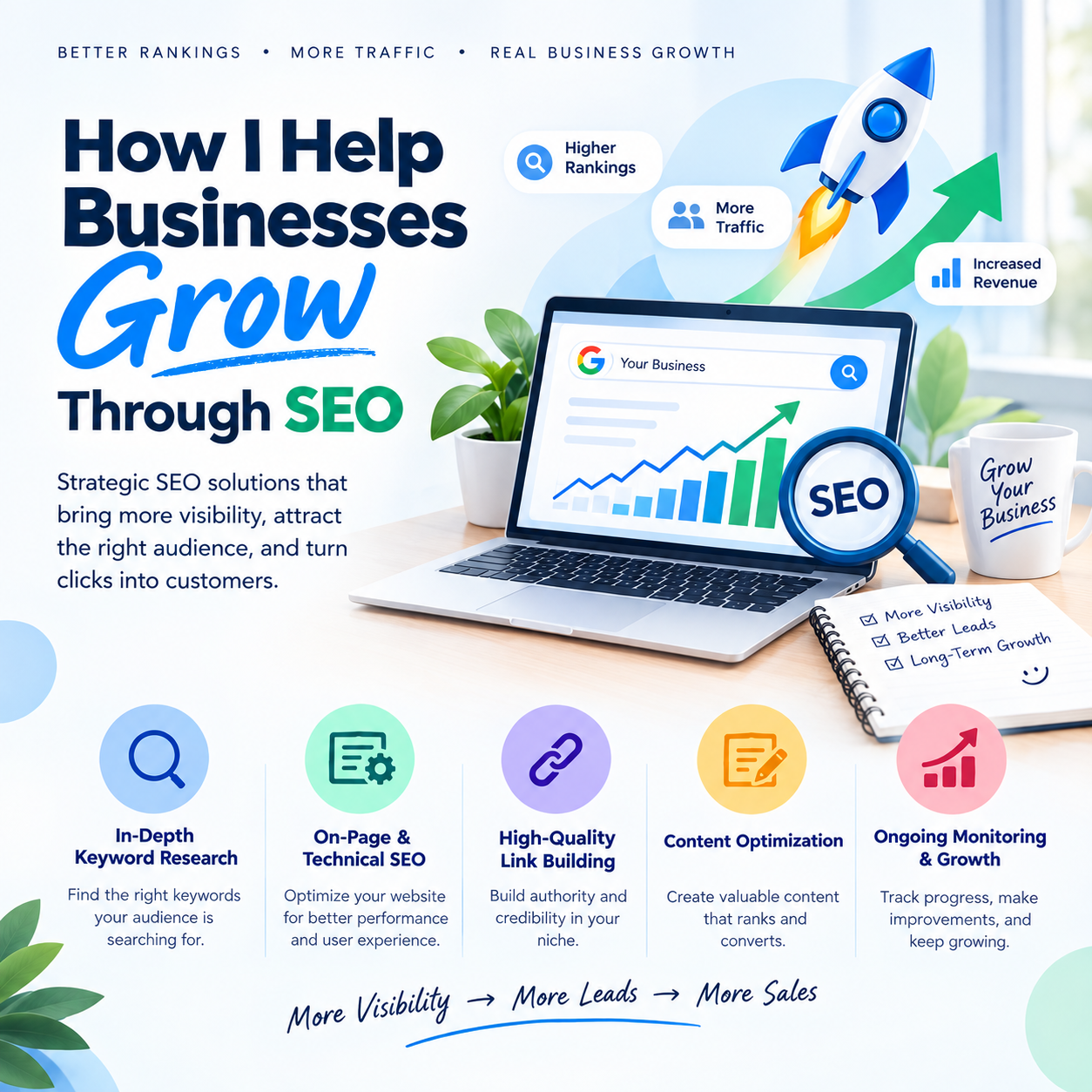
How I Help Businesses Grow Through SEO
SEO is not simply about getting a website to appear on Google. I see SEO as helping businesses improve their online visibility, earn trust, and make it easier for customers to choose them. My name is Sumiya Fariha, and I am an SEO expert in Bangladesh. I help businesses improve their online visibility through practical SEO strategies, including keyword research, website audits, technical SEO, on-page SEO, and off-page SEO.When a business owner tells me, “I want more traffic,” I look beyond traffic. I want to understand which type of traffic will bring real value to the business.A thousand visitors who have no interest in a product or service may be less valuable than a hundred visitors who are actively searching for exactly what the business offers. That is why my approach starts with understanding the business, its audience, competitors, services, and goals before recommending SEO actions.Google's current guidance continues to emphasize helpful, reliable, people-first content rather than content created primarily to manipulate rankings. Google also explains that E-E-A-T—experience, expertise, authoritativeness, and trust—is useful for evaluating content quality, with trust being especially important.My goal is therefore not to promise overnight rankings. My goal is to build a strong SEO foundation that helps a business grow steadily over time. Whether a company is a small local business in Bangladesh, an online service provider, a startup, or an established brand, I use SEO to help the right people find the information they need at every stage of their search journey.
Every business has a different starting point. Some websites have excellent products but almost no organic visibility. Others receive traffic but struggle to convert visitors into leads or customers. Some websites have good content but serious technical problems that prevent search engines from properly discovering or understanding important pages.As an SEO expert in Bangladesh, I don't believe one standard SEO checklist can solve every business problem. I first look at where the website currently stands and then identify the opportunities that can make the biggest difference. This may involve researching keywords, auditing existing pages, improving technical elements, restructuring content, strengthening internal links, or developing an off-page strategy.I also believe SEO should be connected to the bigger marketing picture. Search visibility is useful, but visibility alone is not the final destination. The real objective is to attract relevant visitors, answer their questions, demonstrate value, build confidence, and encourage meaningful actions.
SEO works more like planting and growing a tree than switching on a light. You prepare the foundation, choose the right conditions, nurture the growth, monitor what happens, and make adjustments over time. A website may not become a leading result immediately, but consistent improvements can gradually strengthen its ability to compete.I focus on sustainable SEO because businesses need strategies that can continue creating value rather than temporary tactics that produce short-lived results. Google's own SEO guidance says there are no secrets that automatically rank a site first and emphasizes useful, unique, up-to-date, people-first content.That principle influences how I work. I would rather build a strong keyword strategy and useful content structure than chase random keywords simply because they have high search volume. I would rather fix an important technical problem than make dozens of superficial changes. And I would rather earn relevant authority than pursue backlinks simply to increase a number.
How I Connect SEO With Business Goals
Before implementing SEO, I think about what success actually means for the business. Is the company looking for more product sales? More service inquiries? More local customers? More brand awareness? More qualified leads?These questions affect the SEO strategy.For example, a local service business may benefit from location-focused keyword research and strong local relevance, while an e-commerce website may need a strategy around product categories, transactional searches, product content, and technical crawlability. A professional service provider may need educational content that answers potential clients' questions before they are ready to make contact.
Turning Search Visibility into Business Opportunities
I focus on aligning SEO efforts with each step of the customer journey. Keyword research attracts the right searches, on-page SEO improves relevance, technical SEO helps search engines access the website, and off-page SEO can strengthen authority.The pieces work together. If one part is weak, the entire strategy can become less effective. That’s why I see SEO as a complete strategy where every task works together toward the same goal, rather than a bunch of separate activities.
I start with keyword research because it helps me understand what potential customers are really looking for online. But modern keyword research is not simply about finding a list of phrases and placing them repeatedly throughout a page.I look at search intent, relevance, competition, business value, and the customer's stage in the buying journey. Google also advises creators to think about the terms their users might search for and notes that Google's language systems can understand relationships between queries without requiring every possible variation to be explicitly included.This means a strong keyword strategy should feel natural. The goal is not to make a page sound like a keyword database. The goal is to understand the language customers use and create genuinely useful pages around their needs.
Finding Keywords Based on Search Intent
Search intent helps me understand what people want to find or achieve when they enter a search query. A person searching “what is technical SEO” is likely looking for information. Someone searching for “technical SEO services in Bangladesh” may be comparing different service providers before making a decision. Someone searching for a specific product may already be much closer to purchasing.I use these differences when planning content and page targeting. Informational keywords may be appropriate for blog posts and guides, while commercial or transactional keywords may belong on service, category, or product pages.This helps businesses avoid a common SEO mistake: attracting visitors who are unlikely to become customers.
Creating Keyword Strategies Around Customer Journeys
I also organize keywords around different stages of the customer journey. Someone may first discover a problem, then research solutions, compare providers, and finally make a decision.A website can support each stage with the right content. Educational articles can answer early questions. Service pages can explain solutions. Comparison or case-study-style content can help people evaluate options. Clear calls to action can make the next step easier.This approach makes keyword research much more strategic because every keyword has a purpose.
A website audit gives me a clearer picture of what is happening beneath the surface. Before changing dozens of pages, I want to know whether the existing website has technical, content, structural, or optimization problems that may be limiting performance.A website may look perfectly normal to a human visitor while still having issues that affect search engines. Key pages may be challenging for search engines to crawl. Duplicate versions of URLs may create confusion. Internal links may be weak. Pages may target the wrong keywords. Content may not satisfy the search intent behind important queries.Google's technical requirements state that a page needs to be accessible to Googlebot, return a successful HTTP status, and contain indexable content to be eligible for indexing, although meeting these requirements does not guarantee indexing.
Identifying On-Page SEO Problems
During an audit, I examine important on-page elements such as page titles, headings, content relevance, keyword targeting, internal links, image optimization, and overall content structure.Sometimes a business already has valuable information but presents it poorly. A page may contain valuable information but still have an ineffective title. Another page might rank for an unintended keyword because its topic is unclear. A service page may describe what the company does without explaining why customers should choose it.These are opportunities for improvement rather than reasons to start from zero.
Finding Technical and Content Issues
I also look at technical SEO factors that can affect crawling, indexing, site structure, and user experience. The goal is to make the website easier for both visitors and search engines to navigate and understand.
Why Reguler SEO Audit Matters
SEO requires ongoing attention because websites are constantly evolving. New pages are published, old pages become outdated, URLs change, plugins or templates are updated, and businesses add new products or services.A regular audit can therefore act like a health check. It helps identify problems before they become larger obstacles and shows where the next round of optimization should focus.
Technical SEO is one of my core services because even excellent content needs a strong technical foundation. Think of your website’s content as the products in a store, while technical SEO acts as the roads, entrances, signs, and layout that help people find the store and navigate it easily. I focus on improving the technical aspects of a website so search engines can access, understand, and interpret its pages more effectively. Depending on the website, this may include crawlability, indexation, site architecture, XML sitemaps, robots.txt, canonicalization, redirects, internal linking, mobile experience, page speed, and other technical factors.Google's documentation confirms that foundational SEO practices remain relevant even as Search develops AI features. Google specifically points to crawlability, internal links, page experience, textual content, accurate structured data, and other established SEO fundamentals.
Improving Crawling , Indexing and Site Structure
A well-organized website gives search engines clearer pathways through its content. Internal links help connect related pages, while a logical site architecture helps users and crawlers understand relationships between topics.I pay attention to whether important pages can be discovered efficiently and whether unnecessary or duplicate URLs are creating confusion. I also consider canonical tags, XML sitemaps, robots.txt directives, redirects, and other technical signals when they are relevant to the website.The goal is simple: make important content accessible, understandable, and logically connected.
Improving Page Experience and Core Web Vitals
Technical SEO also involves the user experience. A website that takes too long to load or behaves unpredictably can frustrate visitors before they even see the content.Google's Core Web Vitals measure loading performance, responsiveness, and visual stability. Its current guidance identifies good targets including LCP within 2.5 seconds, INP below 200 milliseconds, and CLS below 0.1.I therefore consider page performance as part of a broader SEO and user-experience strategy rather than treating technical optimization as something separate from real people.
Making Technical SEO Support Long-Term Growth
The purpose of technical SEO is not to make a website technically impressive just for the sake of it. Every technical improvement should support discoverability, usability, relevance, or business performance.That mindset keeps technical SEO practical. I prioritize issues based on their potential impact instead of recommending complicated changes simply because they sound advanced.
On-page SEO is where I make sure a page clearly communicates its topic and provides a useful experience for visitors. This includes optimizing titles, headings, content, URLs, images, internal links, and other page elements.However, I don't approach on-page SEO as keyword stuffing. Google's guidance emphasizes content created primarily for people and warns against creating search-engine-first content.For me, successful on-page SEO means answering the searcher's question clearly while making the page easy to understand and navigate.
Optimizing Content for Users and Search Engines
I start with the purpose of the page. What key takeaway should visitors get from reading it?What question brought them there? What details would help them make an informed decision?Then I optimize the content around those needs.I naturally incorporate relevant keywords, related concepts, descriptive headings, useful examples, and clear explanations. The keyword becomes part of the strategy rather than the entire strategy.This is particularly important today because search systems are becoming better at understanding meaning and context. Google's 2026 guidance for generative AI search also emphasizes unique, valuable, non-commodity content and says that established SEO fundamentals remain foundational.
Building Strong Internal Linking and Content Structure
Internal linking helps users discover related information and helps search engines understand the relationships among pages. I use relevant internal links to connect supporting content with important service or commercial pages.For example, a detailed article about keyword research could naturally link to a keyword research service page. An article about website performance could connect to a technical SEO service. This creates a more useful website ecosystem instead of leaving valuable pages isolated.
Off-page SEO focuses on signals and activities beyond the individual page. One important area is building relevant authority through quality relationships, mentions, references, and backlinks.My approach is not based on collecting as many links as possible. Relevance and quality matter more than raw quantity. A backlink from a genuinely relevant and trustworthy source can be much more meaningful than a large number of unrelated links.I also think about off-page SEO as reputation building. A business should become recognized as a useful source within its industry rather than simply trying to manipulate link metrics.
Building Relevant and Natural Authority
A strong off-page strategy begins with something worth referencing. Helpful resources, original insights, useful guides, expert contributions, valuable data, and genuinely useful business information can create reasons for others to mention a website.That is why off-page SEO should connect with content strategy. If the website has nothing valuable to offer, link building becomes much harder and often turns into a numbers game.
Why Quality Matters More Than Quantity
Imagine two businesses. One has hundreds of random backlinks from unrelated websites. The other has a smaller number of relevant references from sources connected to its industry and audience.The second profile may provide a stronger foundation because the links make contextual sense. Search engines increasingly focus on relevance and quality, so I prefer a thoughtful, sustainable approach instead of aggressive tactics.
Measuring Off Page SEO Progress
I evaluate off-page progress through more than backlink counts. I consider the relevance and quality of referring domains, improvements in authority-related signals, referral traffic, brand visibility, and changes in organic performance.The ultimate question is not “How many links did we get?” It is “Did our website become more credible and more discoverable to the right audience?”
My E-E-A-T Approach to Sustainable SEO Growth
E-E-A-T is especially important to the way I think about SEO because it encourages content and websites to demonstrate genuine value. Google describes E-E-A-T as experience, expertise, authoritativeness, and trustworthiness, while also clarifying that E-E-A-T itself is not a single ranking factor.For my own SEO work, this means being transparent about who is behind the content, providing useful expertise, supporting claims appropriately, and focusing on the actual needs of the audience.I don't want a business website to look like a collection of generic SEO pages. I want it to communicate why the business is qualified, what it does, how it works, and why potential customers can trust it.
Combining Experience , Expertise, Authority and Trust
Experience can come from real involvement with the subject. Expertise comes from knowledge and the ability to explain that knowledge clearly. Authority grows when a business becomes recognized as a reliable source. Trust comes from accuracy, transparency, credibility, and a good user experience.These elements strengthen one another.For my clients, I look for ways to make their genuine experience and expertise more visible through website content. Author information, service explanations, useful educational resources, transparent business information, original insights, and clear communication can all contribute to a more trustworthy online presence.
Tracking SEO Performance and Business Outcomes
SEO should be measured because assumptions can be misleading. I monitor meaningful indicators such as organic visibility, keyword performance, impressions, clicks, landing-page performance, relevant traffic, conversions, and other business-specific goals.I also believe SEO reporting should explain what the numbers mean. A ranking increase is useful, but what happened to traffic? Did the traffic come from relevant searches? Did important landing pages improve? Did leads or inquiries increase?Google's current guidance around generative AI search also encourages website owners to use Search Console insights to understand visibility in newer AI-powered search experiences.That reinforces an important principle: SEO measurement should evolve with search, but the business objective remains the same—reaching the right people with valuable information.
How I Help Businesses Grow Through SEO is ultimately about more than rankings. As an SEO expert in Bangladesh, I use keyword research, website audits, technical SEO, on-page SEO, and off-page SEO to create a connected strategy designed around sustainable visibility and meaningful business growth.I begin by understanding the business and its audience. Then I research what potential customers are searching for, identify website problems, improve technical foundations, optimize important pages, strengthen internal structure, and work toward building relevant authority. Throughout the process, I keep the user in focus because SEO works best when search visibility and genuine value move in the same direction.Search is also changing quickly. Google's current documentation shows that AI-powered search experiences are creating new ways for people to discover websites, while foundational SEO practices continue to matter.That is why I don't believe businesses need to chase every new SEO trend. They need a strong foundation, useful content, technical accessibility, relevant authority, and a clear understanding of their customers.If you're looking for SEO support, my approach is simple: understand the opportunity, build the strategy, improve the website, measure the results, and keep improving. That is how I help businesses grow through SEO.