
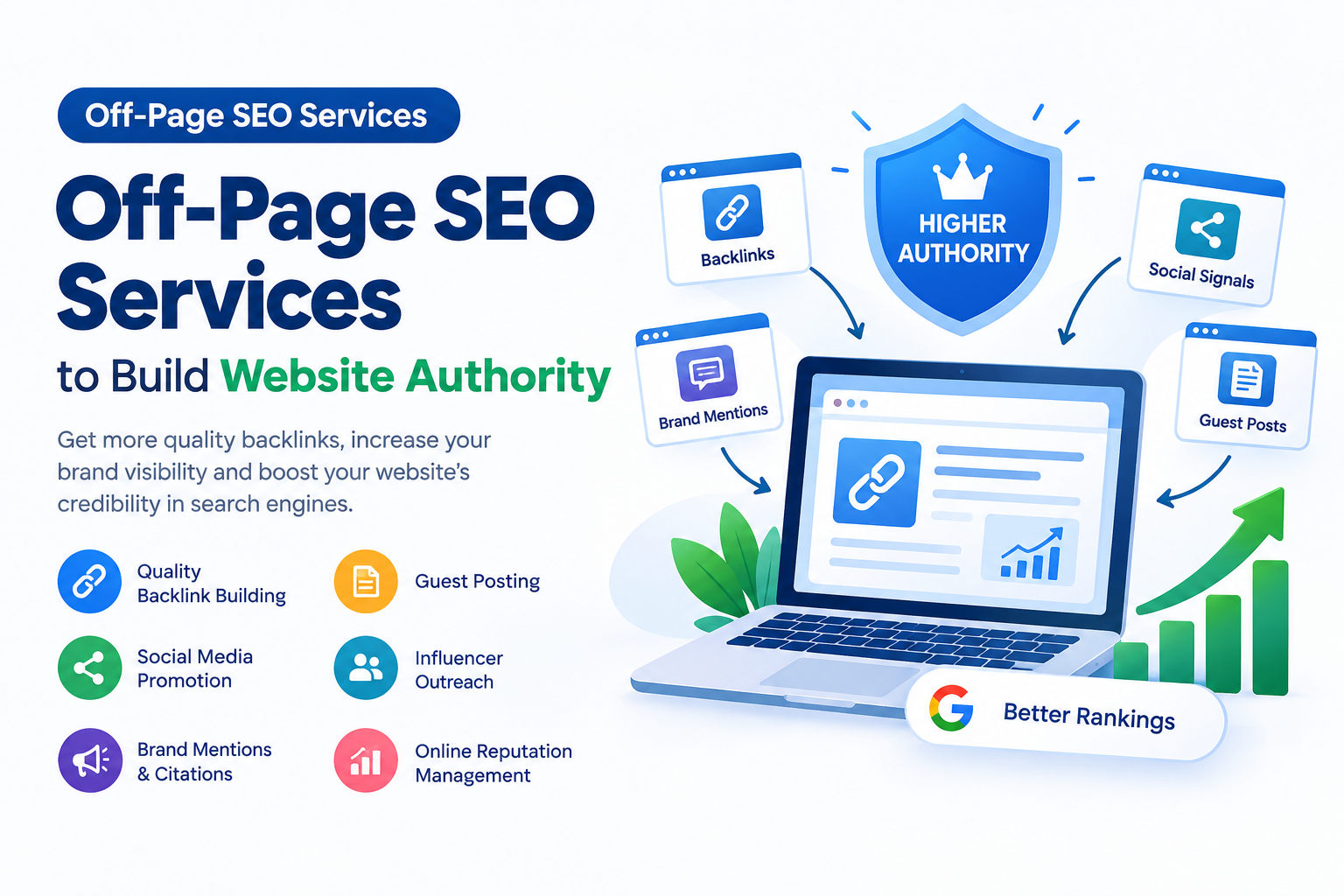
Off-Page SEO Services to Build Website Authority
Building a successful website is not simply about publishing articles, adding keywords, or optimizing title tags. Those things matter, but there is another side of SEO that happens beyond your own website. This is where off-page SEO becomes important. Off-page SEO focuses on the signals, relationships, mentions, links, reputation, and visibility your website earns across the wider web. When other relevant and trustworthy websites reference your business, discuss your expertise, or naturally link to useful resources on your site, they can help strengthen your online presence. As an SEO expert in Bangladesh, Sumiya Fariha, I approach off-page SEO as a long-term authority-building process rather than a race to collect as many backlinks as possible.My goal with Off-Page SEO Services to Build Website Authority is to help businesses develop a stronger and more trustworthy digital presence through strategic, relevant, and sustainable SEO activities. I do not believe that hundreds of random backlinks automatically create a successful website. In fact, Google specifically identifies practices such as buying links for ranking manipulation, excessive link exchanges, automated link creation, low-quality directories, and other manipulative approaches as link spam. My approach is all about building relevant, high-quality backlinks that provide real value and grow naturally over time. A good off-page strategy should support your brand, attract the right audience, improve discoverability, and contribute to sustainable organic growth instead of creating short-term numbers that may become a problem later.
Off-page SEO includes activities that influence how your website is perceived beyond the pages you directly control. Backlinks are one of the most recognizable parts of off-page SEO, but the concept is broader than link building alone. Brand mentions, digital PR, relevant publications, local citations, relationship building, content promotion, and reputation signals can all contribute to a website's overall presence on the web. Think of your website as a professional standing in a crowded business community. Your own website tells people who you are, what you offer, and what you know, but recommendations and references from credible people and organizations can make your reputation stronger. That is essentially the idea behind authority-building through off-page SEO.For businesses competing in crowded search results, this external credibility can be especially valuable. Imagine two businesses offering similar services. One has a website with useful content but almost no external recognition, while the other is regularly mentioned by relevant publications, industry websites, local resources, and communities. The second business has built a stronger online presence across different platforms. My role is to help build that footprint strategically. Off-Page SEO Services to Build Website Authority should therefore be viewed as a complete visibility strategy rather than simply a backlink package.
Why Website Authority Matters in Modern SEO
Website authority matters because search engines need to evaluate countless websites competing for the same queries. A website can make excellent claims about its own expertise, but external references can provide additional context. When relevant websites naturally reference your content or business, those references can contribute to your broader online credibility. However, authority should never be reduced to one third-party metric. Domain Rating, Domain Authority, Trust Flow, and similar measurements can be useful for comparing backlink profiles, but they are not official Google ranking scores.This distinction is important when evaluating an SEO campaign. A backlink from a website with high authority metrics isn’t always valuable. If the site isn’t relevant, the page offers little value to readers, or the link was created just to manipulate rankings, it may not be worth much. I look at the bigger picture: topical relevance, editorial context, website quality, link placement, referring-domain diversity, brand relevance, and the potential for the relationship to produce meaningful visibility. This approach builds a stronger foundation for lasting SEO growth.
Authority Is More Than a Number
One of the biggest misconceptions about off-page SEO is that authority can be summarized by a single number. A business owner may see a competitor with a higher Domain Authority and immediately assume that obtaining dozens of similar links will solve the problem. SEO rarely works that simply. A website's competitive strength can depend on its content quality, technical foundation, topical relevance, backlinks, brand recognition, search intent alignment, user experience, and many other factors.This is why I avoid treating third-party authority scores as the final destination. Instead, I use them as supporting indicators while examining the actual backlink ecosystem. A strong backlink is usually connected to a meaningful context. If a respected website within your industry references your guide because it genuinely helps its readers, that relationship can be much more meaningful than a large collection of unrelated directory links. The objective is not to manufacture authority; it is to build a digital reputation that makes sense.
How I Approach Off-Page SEO as an SEO Expert in Bangladesh
As an SEO expert in Bangladesh, I understand that businesses can have very different goals. A local Bangladeshi business may want to dominate searches in Dhaka or another city, while an e-commerce company may want visibility across international markets. A service provider may need more qualified leads, whereas a publisher may care more about organic traffic and content visibility. That means off-page SEO should not begin with a generic list of websites where links can be placed. It should begin with understanding the business, its audience, competitors, market, existing authority, and realistic growth opportunities.My process is designed around strategy before execution. I first examine the website and its current external signals, then identify weaknesses and opportunities. From there, I can develop a link acquisition and digital visibility strategy based on relevance and quality. I also consider what kind of content is worth promoting because even the best outreach strategy becomes difficult when the destination content offers little value. Off-Page SEO Services to Build Website Authority work best when technical SEO, on-page SEO, content, and off-page activities support each other.
An off-page SEO audit gives me a clearer understanding of where a website currently stands. I examine existing backlinks, referring domains, anchor-text patterns, potentially harmful or suspicious links, competitor profiles, brand mentions, and opportunities for earning better visibility. I also look at whether backlinks are coming from relevant websites or whether the profile is dominated by unrelated sources. This helps identify what should be strengthened and what should be approached cautiously.An audit can also reveal missed opportunities. Perhaps competitors are being mentioned in industry publications while your business is invisible in those conversations. Perhaps your existing content deserves links but has never been promoted properly. Maybe your local business information is inconsistent across external platforms. These discoveries can shape the next stage of the campaign. Instead of blindly building links, I use the audit to decide what kind of external signals would make the most sense for the business.
Understanding Competitors and Their Link Profiles
Competitor analysis is another important part of my off-page SEO process. I study where competitors are receiving relevant backlinks, what types of content attract references, which publications mention them, and how their backlink profiles have developed. The purpose is not to copy every link they have. That would be like copying another company's entire marketing plan without understanding its customers.Instead, competitor research helps reveal patterns and opportunities. If several competitors are being referenced by a particular industry publication, that publication may be worth researching. If a competitor's original research attracts links, perhaps your business can create a stronger or more useful resource. If competitors have strong local citations, that may reveal a local visibility gap. This is how competitive research becomes a strategic tool rather than a simple backlink-counting exercise.
My Core Off-Page SEO Services
My Off-Page SEO Services to Build Website Authority are designed around sustainable external visibility. Depending on the website, industry, competition, and business objectives, the strategy can include link-building research, outreach, guest contributions, digital PR opportunities, brand mention development, competitor backlink analysis, local citations, and content promotion. Every campaign does not require every tactic. The right mix depends on what can realistically create value for the business.I believe off-page SEO should feel connected to the brand. If your company sells professional services, for example, earning a mention from a relevant industry resource makes more sense than appearing on dozens of unrelated websites. If you run a local business, regional publications and trustworthy local resources may be more useful. If you publish specialized content, expert commentary, original research, and useful guides may create stronger opportunities for natural references. The strategy should follow the business rather than forcing the business into a predefined backlink package.
High-Quality Link Building
Link building is one of the most important components of off-page SEO, but quality matters far more than simply increasing the backlink count. I focus on identifying websites that are relevant to the client's niche, audience, location, or subject matter. The goal is to earn or acquire links within meaningful contexts where the destination page genuinely provides value. This may involve outreach, resource promotion, relationship development, content contributions, digital PR, or other legitimate methods.A good backlink should make sense even if Google did not exist. Ask yourself: would this link help a real reader discover something useful? If the answer is yes, you are starting from a healthier position. If the only reason the link exists is to manipulate rankings, the strategy becomes much riskier. Google's current spam policies explicitly identify buying or selling links for ranking purposes, excessive link exchanges, automated link-building services, and low-quality directory links among examples of link spam. My philosophy is simple: build relationships and useful references, not artificial link counts.
Relevance and Editorial Value Come First
Relevance is one of the first things I consider when evaluating a potential backlink opportunity. A link from a website that discusses your industry, location, audience, or subject matter can make more contextual sense than a link from a completely unrelated site. Editorial value matters too. A link placed naturally within useful content can provide readers with a reason to visit the destination page.This is why I prefer a smaller number of meaningful opportunities over a huge number of questionable ones. Imagine one website has 500 backlinks from unrelated sites but gains little referral traffic or brand exposure. Meanwhile, another website earns just 20 relevant links from trusted, well-known resources in its industry. The second profile may be much more strategically useful. Off-page SEO should therefore focus on context, relevance, trust, and usefulness, not vanity metrics.
Guest Posting and Digital PR
Guest posting can be useful when it is approached as genuine publishing rather than a shortcut for inserting keyword-rich links. A strong guest contribution should provide something valuable to the publication's audience. It should demonstrate expertise, answer a real question, offer practical insights, or contribute an original perspective. The link should support the reader rather than interrupt the content.Digital PR takes this idea further by creating reasons for other websites and publications to discuss your brand. Original research, expert commentary, industry insights, useful statistics, case studies, unique resources, and newsworthy developments can all create opportunities for external coverage. I like this approach because it connects SEO with brand building.
Brand Mentions and Online Reputation
Not every valuable off-page activity starts with a hyperlink. Brand mentions can increase awareness and help establish a wider digital footprint. When people discuss a business, cite its expertise, mention its research, or reference its resources, those conversations can contribute to brand visibility even when the specific SEO value of an individual mention is difficult to quantify.For me, reputation is a major part of authority. A website should be connected to the wider online ecosystem. It should have a recognizable identity across relevant channels and communities. That is particularly important for professionals and service providers because potential clients often research a business before making contact. A consistent and credible online presence can help bridge the gap between search visibility and customer trust.
How Ethical Link Building Builds Long-Term Authority
Ethical link building is not about finding loopholes. It is about creating legitimate reasons for websites to reference your business. That usually requires patience because genuine relationships take time. You may need to create better content, identify the right websites, personalize outreach, establish connections with publishers, and repeatedly demonstrate that your business has something useful to contribute.This approach also makes SEO more resilient. Search algorithms and policies continue to evolve, so tactics based on manipulation can become increasingly risky. Google's current guidance clearly warns against link spam and low-value content created primarily to manipulate ranking signals. I focus on earning relevant, valuable links that continue to support long-term SEO growth as search engines evolve.
Natural Anchor Text and Link Diversity
Anchor text is the clickable text that people see in a link. It can help provide context about the linked page, but aggressively optimizing every backlink around an exact-match keyword can create an unnatural profile. A healthy backlink profile can contain a natural mix of branded terms, URLs, descriptive phrases, partial-match phrases, and other contextually appropriate language.I do not recommend forcing the exact keyword Off-Page SEO Services to Build Website Authority into every backlink.That would make the backlink profile look unnatural and make the content less helpful for readers. Natural language should lead the strategy. When someone links to a page because it offers a helpful guide, the anchor text should flow naturally with the surrounding sentence. SEO should work with human communication, not fight against it.
Quality Over Quantity in Backlink Acquisition
I would rather build ten highly relevant relationships than chase hundreds of random links. Quality-first link acquisition requires research because you need to understand the website, its audience, its content standards, and whether the opportunity actually fits the client's brand. That extra work is exactly what separates strategic off-page SEO from bulk backlink packages.Think of backlinks like professional recommendations. If ten respected professionals in your industry recommend your work, that can be meaningful. If thousands of unrelated accounts repeat your name without context, the numbers may look impressive but the reputation behind them is weak. Website authority is earned through credibility, and credibility usually develops through consistency rather than shortcuts.
Small businesses in Bangladesh can benefit significantly from a locally focused off-page SEO strategy. A business may have a strong website but still struggle to appear prominently when customers search for services in a specific city or area. Local visibility can involve consistent business information, relevant local citations, community mentions, industry associations, local publications, and other trustworthy external references. The strategy should reflect the location and customer behavior of the business.As an SEO expert in Bangladesh, I understand the importance of creating strategies that fit the local market instead of simply copying international SEO tactics. A Dhaka-based service provider, for example, may need a different off-page approach from a Bangladesh-based e-commerce company targeting customers in multiple countries. Local businesses should also pay attention to how their brand is represented across external platforms. Consistency helps users understand that different references belong to the same legitimate business.
Local Citations and Business Visibility
Local citations are online references to a business's information, such as its name, address, phone number, website, and other relevant details. Accurate and consistent business information can make it easier for customers and search systems to understand the business. However, citation building should also be selective. Submitting a business to every directory available on the internet is not necessarily a smart strategy.I focus on relevant and trustworthy platforms rather than volume. Industry directories, local business resources, professional associations, community websites, and other legitimate platforms can be considered depending on the business. The objective is to create a reliable digital footprint that supports both discoverability and customer confidence. For a local company, Off-Page SEO Services to Build Website Authority should connect traditional link-building principles with local brand visibility.
Measuring the Success of Off-Page SEO
SEO success cannot be measured by backlinks alone. A strong campaign should be evaluated through multiple signals, including organic rankings, referring domains, relevant referral traffic, brand visibility, indexed content, conversions, and business outcomes. Some links may produce referral traffic immediately, while others may contribute more indirectly to broader authority and visibility. That is why I prefer to evaluate campaigns over time rather than making decisions based on one week's numbers.Google's Search Central documentation continues to evolve, with new guidance and updates being published throughout 2026. For example, Google's documentation updates include new guidance around analyzing social and video platform content performance in Search Console and updates to other search-related documentation. This ongoing evolution is another reason SEO reporting should focus on meaningful business outcomes rather than relying on a single fixed formula.
Tracking Rankings, Referring Domains, and Organic Growth
When monitoring an off-page campaign, I look at whether the website is earning relevant referring domains and whether organic visibility is improving. I also examine which pages are attracting attention and whether the links are helping users discover valuable resources. Ranking changes can provide useful evidence, but rankings should be connected to actual business goals.For example, a business might increase organic traffic but still receive very few inquiries because it is attracting the wrong audience. Another company might gain fewer visitors but generate significantly more qualified leads from the traffic it receives. This is why SEO reporting should connect visibility with intent and conversions. The purpose of Off-Page SEO Services to Build Website Authority is not simply to collect backlinks; it is to help create sustainable online growth.
Why SEO Results Need Time and Consistency
Off-page SEO rarely produces meaningful results overnight. Building relationships, earning mentions, publishing valuable content, attracting relevant backlinks, and developing a recognizable brand presence takes time. Anyone promising guaranteed rankings or instant authority through a fixed number of backlinks should be approached carefully. SEO is closer to building a reputation than flipping a switch.I set realistic expectations because sustainable growth is more valuable than temporary excitement. A strong campaign may involve research, outreach, content improvements, relationship building, monitoring, and repeated refinement. Some opportunities work quickly, while others take months to produce meaningful visibility. The key is consistency. When off-page SEO is combined with strong technical SEO, useful content, good on-page optimization, and a positive user experience, it becomes part of a broader growth system rather than an isolated tactic.
Off-Page SEO Services to Build Website Authority are about much more than collecting backlinks. They are about developing the external credibility, relevance, visibility, and reputation that help a business establish itself online. As Sumiya Fariha, an SEO expert in Bangladesh, my approach is centered on strategic and ethical off-page SEO rather than shortcuts. I focus on relevant link opportunities, quality content promotion, competitor research, digital PR, brand visibility, local opportunities, and sustainable relationship building.The most important lesson is simple: quality beats quantity. A website does not become authoritative because someone created hundreds of random links pointing toward it. It becomes stronger when its content is useful, its brand is credible, and relevant websites have genuine reasons to reference it. Google's current policies make it especially important to avoid manipulative link-building practices such as buying links for ranking purposes, automated link creation, excessive link exchanges, and low-quality directory links.If your website has good content but is struggling to gain visibility, off-page SEO may be the missing piece. With the right research and a long-term strategy, external SEO can help turn an isolated website into a recognized and trusted presence within its industry. That is the purpose behind my Off-Page SEO Services to Build Website Authority: not just more links, but a stronger foundation for long-term SEO growth.