
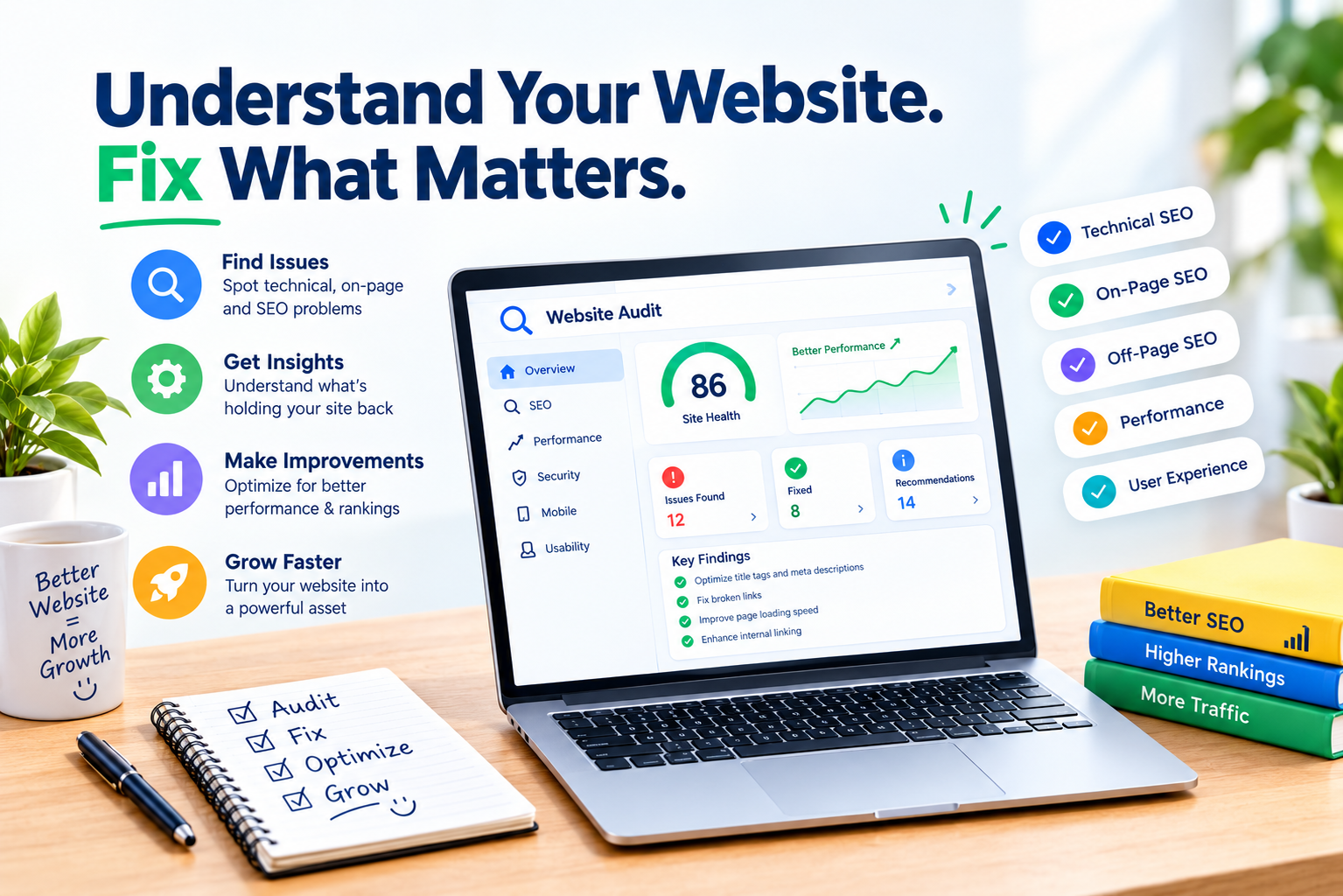
Understand Your Website. Fix What Matters.
A website can look beautiful and still struggle to attract visitors, generate leads, or rank well in search results. I have learned as an SEO professional that the real challenge is not simply creating a website; it is understanding what is happening underneath it. When I work on SEO, I do not want to change everything just because an SEO tool produces a long list of warnings. I want to understand the website first, identify the problems that can actually affect visibility or users, and then prioritize the fixes that can make a meaningful difference. That is the thinking behind my approach: Understand Your Website. Fix What Matters.I’m Sumiya Fariha, an SEO expert in Bangladesh, and I believe effective SEO starts with diagnosis rather than random optimization. Google itself provides tools such as Search Console to help website owners understand search performance and indexing, while its current documentation emphasizes technical requirements, search appearance, crawling, indexing, and overall page experience. A website is much like a house: before renovating the kitchen, you need to know whether the foundation, plumbing, electricity, and structure are working properly. SEO works the same way. If your website has serious technical, content, indexing, or user-experience problems, publishing more content may not solve the real issue.
Many website owners begin SEO by asking, “Which keyword should I target?” That is an important question, but it should not always be the first one. Before choosing keywords or building backlinks, you need to understand how your website currently performs, what search engines can access, which pages are indexed, what users are looking for, and where visitors are experiencing friction. Without that information, SEO becomes guesswork. You may spend weeks optimizing pages that Google cannot properly crawl, promoting content that does not match search intent, or improving technical elements that have little practical impact.When I analyze a website, I try to see the complete picture rather than focusing on one SEO score. A website can have a high audit score and still fail to attract qualified visitors. Another website may have several technical warnings but perform well because its content satisfies users and its most important pages are accessible and useful. Google explains that page experience involves multiple aspects, including Core Web Vitals, mobile usability, HTTPS, intrusive elements, and whether the main content is easy to distinguish. It also makes clear that there is no single page-experience signal that guarantees ranking success.That is why my philosophy is simple: understand first, prioritize second, fix third, measure continuously.
Understand Your Website. Fix What Matters. Starts With a Real SEO Audit
A proper SEO audit is not just about generating a report full of red, orange, and green icons. An audit should answer practical questions. Can search engines easily access your most important pages? Are valuable pages indexed? Are there duplicate or competing pages? Does your content match what people are looking for? Do your internal links help visitors and search engines find important pages? Is your website technically sound enough to provide a smooth user experience?
What I Look for During a Website Audit
I normally divide a website audit into several connected areas: technical SEO, on-page SEO, content quality, internal linking, indexing, user experience, and competitive opportunities. This approach makes the audit more useful because it connects individual problems to business objectives instead of treating every warning equally.For example, imagine an SEO crawler reports 300 missing image alt attributes. That may deserve attention, but perhaps the website's most important service pages are accidentally blocked from crawling. Which problem should be fixed first? Obviously, the crawling problem deserves greater priority because it can prevent search engines from properly accessing valuable content. This is exactly why an SEO audit should be based on impact rather than the number of errors.Google's Search Central documentation recommends using Search Console to monitor search performance and indexing, making it an important source of first-party information when diagnosing a website.
Technical SEO Problems need Smart Prioritization
Technical SEO includes many elements: crawlability, indexability, redirects, canonical URLs, XML sitemaps, robots.txt, HTTPS, mobile experience, structured data, page speed, JavaScript rendering, and internal site architecture. Not all technical issues need to be fixed right away. Some problems can directly prevent important pages from being crawled or indexed, while others may be minor recommendations with little immediate business impact.I prefer to classify technical issues according to severity, affected pages, search impact, user impact, and implementation difficulty. A widespread noindex problem on important landing pages is obviously more urgent than a small metadata inconsistency on a low-value page. This prioritization saves time and prevents businesses from wasting resources on technical changes that do not meaningfully improve the website.
Understand Your Website. Fix What Matters. Through Search Intent
Technical SEO is just one piece of the puzzle. A technically perfect website can still struggle if its content does not answer the questions people are actually asking. This is where understanding search intent really matters. Every keyword represents a reason behind a search, and understanding that reason helps determine what kind of page should be created or optimized.Someone searching for “SEO services in Bangladesh” may be looking for a service provider. Someone searching for “how does SEO work” is probably looking for educational information. Someone searching for “best SEO tools” may be comparing products or looking for recommendations. Treating all three searches as if they have the same intent can create content that technically targets the keyword but fails to satisfy the visitor.
Match Content With What Users Actually Want
When I optimize a page, I ask myself a simple question: If I were searching this keyword, would this page genuinely give me what I need? If the answer is no, adding more keywords will not solve the problem.Search intent should influence the page structure, content depth, examples, calls to action, visuals, and internal links. It should also influence whether you need a blog post, service page, category page, product page, landing page, or another format.This is where SEO becomes more strategic. Instead of writing content simply because a keyword has search volume, you build a page around the user's actual problem. That approach can improve relevance, engagement, and the overall usefulness of the website.
One common SEO mistake is trying to optimize every page at once. Instead, it’s better to focus on the pages that have the biggest impact on your business. These might include the homepage, primary service pages, important product pages, high-traffic blog posts, lead-generation landing pages, or pages that already rank on the second page of Google.Once these pages are identified, I examine their performance and opportunities. Is the title compelling? Does the introduction quickly answer what the reader is looking for? Is the main keyword naturally represented? Does the page demonstrate expertise? Are supporting topics covered? Are there useful internal links? Is the call to action clear?Updating a page that already offers value can sometimes be more effective than publishing ten more average articles.
Improve Content Before Simply Adding More Content
More content does not automatically mean more SEO success. If a website already contains dozens of pages covering similar topics, publishing another nearly identical article may create unnecessary competition between pages. In some cases, the better solution is to consolidate overlapping content, improve an existing page, or create a clearer content hierarchy.I like to think of a website as a library. If every book is thrown onto the same shelf without organization, adding more books does not make the library better. You need categories, labels, pathways, and useful information. A well-organized website works in a similar way.
Technical SEO: Find the Problems That Can Block Growth
Technical SEO becomes especially important when a website has crawling, indexing, performance, or architectural problems. Search engines need to access and understand your pages before those pages can compete effectively in organic search.An XML sitemap can help communicate important URLs to search engines, while robots.txt can control crawler access. Canonical URLs can help signal the preferred version of duplicate or substantially similar pages. Internal links can help users and search engines discover related content and understand relationships between pages.Google recommends making sure pages are accessible, checking structured data for errors, and using tools like URL Inspection and Search Console when needed.
Core Web Vitals and User Experience Matter
Website performance is more than just a technical score; it also shapes how visitors experience your site. A page that loads slowly, shifts unexpectedly, or responds poorly can frustrate users before they even read the content.Google currently identifies Core Web Vitals as part of its page-experience considerations, while also emphasizing that strong Core Web Vitals alone do not guarantee top rankings. That distinction is important. The goal should not be to chase a perfect score for its own sake. The goal should be to create a website that is fast, stable, responsive, accessible, and useful.That means optimizing large images, reducing unnecessary scripts, improving hosting where necessary, addressing layout shifts, and ensuring important content becomes usable quickly.
On-Page SEO: Make Every Important Page Clear
On-page SEO brings your content and website structure together. Search engines need signals that help them understand what a page is about, while users need clear information that helps them decide whether the page is relevant.I pay attention to page titles, headings, introductions, URLs, image optimization, internal links, content structure, keyword usage, and search intent. I don’t believe in forcing the same keyword into every sentence. Instead, I focus on making the topic unmistakably clear while using related concepts naturally.A strong page should feel like it was written for a person first, not a robot.
Use Headings to Organize Your Content Clearly
Headings should guide readers through the topic. Your H1 should communicate the main subject of the page, while H2s and H3s should divide the information into logical sections. If the page discusses several related questions, those questions can become useful subheadings.For my own SEO content, I like headings that are descriptive rather than generic. Instead of using “Services” as a heading, a more meaningful heading could explain exactly what the section offers. Clear headings make longer content easier to read and help visitors find what they’re looking for faster.
Internal Linking Can Reveal How Well You Understand Your Website
Internal links are often underestimated. They are not merely navigation elements; they help connect related information throughout your website. A thoughtful internal-linking strategy can guide users from broad topics to detailed resources and from informational content toward relevant commercial pages.For example, a blog post about keyword research could naturally link to a keyword research service page .A technical SEO article could link to a related website audit service. A guide about local SEO could connect to a local SEO consultation page.This creates a journey instead of isolated pages.
Build Topic Relationships Instead of Random Links
The goal isn’t to add internal links to every page just for the sake of it. Each link should have a reason. Ask whether the destination page adds useful context for the reader. If it does, the link can strengthen both usability and the site's information structure.I often think about internal linking as building roads between neighborhoods. Important pages shouldn’t feel disconnected from the rest of your website. They should be connected to relevant content so users and crawlers can move naturally through the website.
Understand Your Website Through Search Console Data
One of the most valuable resources available to website owners is Google Search Console. It provides information about search performance and helps site owners understand how Google sees their websites. Google specifically describes Search Console as a tool for monitoring search performance and checking whether pages can be indexed.Instead of looking only at total clicks, I like to examine impressions, clicks, queries, pages, indexing issues, and changes over time. A page receiving many impressions but few clicks may need a stronger title or snippet. A page receiving clicks but failing to generate conversions may have a content or offer problem. A page disappearing from search may require deeper technical investigation.The numbers are not the strategy. They are clues that help you build the strategy.
Why I Believe “Understand Your Website. Fix What Matters.” Is a Better SEO Mindset
SEO is an ongoing process that requires continuous analysis, strategic adjustments, and consistent optimization to maintain and improve search visibility. Search behavior changes, competitors publish new content, websites evolve, algorithms change, and businesses introduce new products or services. A website that was healthy six months ago may have problems today because of a redesign, plugin update, migration, deleted page, or technical change.Google's documentation continues to evolve, and its Search Central updates show ongoing changes and clarifications around search features, AI features, structured data, page experience, and Search Console reporting.That is why I approach SEO as an ongoing process of understanding, improving, testing, and learning.
My SEO Philosophy as an SEO Expert in Bangladesh
As Sumiya Fariha, an SEO expert in Bangladesh, I want my work to go beyond simply delivering an audit report. My goal is to understand the business behind the website. What does the company sell? Who are its customers? Which services generate revenue? Which markets matter? What competitors are taking visibility? What pages deserve the most attention?Once those questions are answered, SEO becomes much more focused.I believe businesses should not have to choose between technical SEO and useful content. The strongest websites need both. They need a foundation that search engines can access and a content experience that people actually appreciate.
A Simple Framework: Understand, Prioritize, Fix, Measure
My approach can be summarized in four steps: understand, prioritize, fix, and measure.First, understand the website from technical, content, search, and business perspectives. Second, prioritize the issues based on potential impact rather than the number of warnings. Third, fix the problems systematically, starting with the issues that can block visibility, usability, or conversions. Finally, measure the results and use the data to decide what should happen next.This framework prevents SEO from becoming a never-ending list of random tasks.It also keeps the focus where it belongs: business growth and user value.
A successful SEO strategy does not begin with blindly fixing every warning an SEO tool can find. It begins with understanding the website. When you know how your pages are crawled, indexed, structured, written, linked, and experienced by users, you can make much smarter decisions about what deserves attention.That is why my SEO philosophy is simple: Understand Your Website. Fix What Matters.As an SEO expert in Bangladesh, I believe good SEO should combine technical knowledge, content strategy, search intent, data analysis, and practical business thinking. You don’t have to make all the changes at once. You need to identify the problems that matter, fix them properly, measure the outcome, and continue improving.A website is never truly “finished.” There is always another opportunity to make it clearer, faster, more useful, and more competitive. The real skill is knowing which opportunity deserves your attention first.