
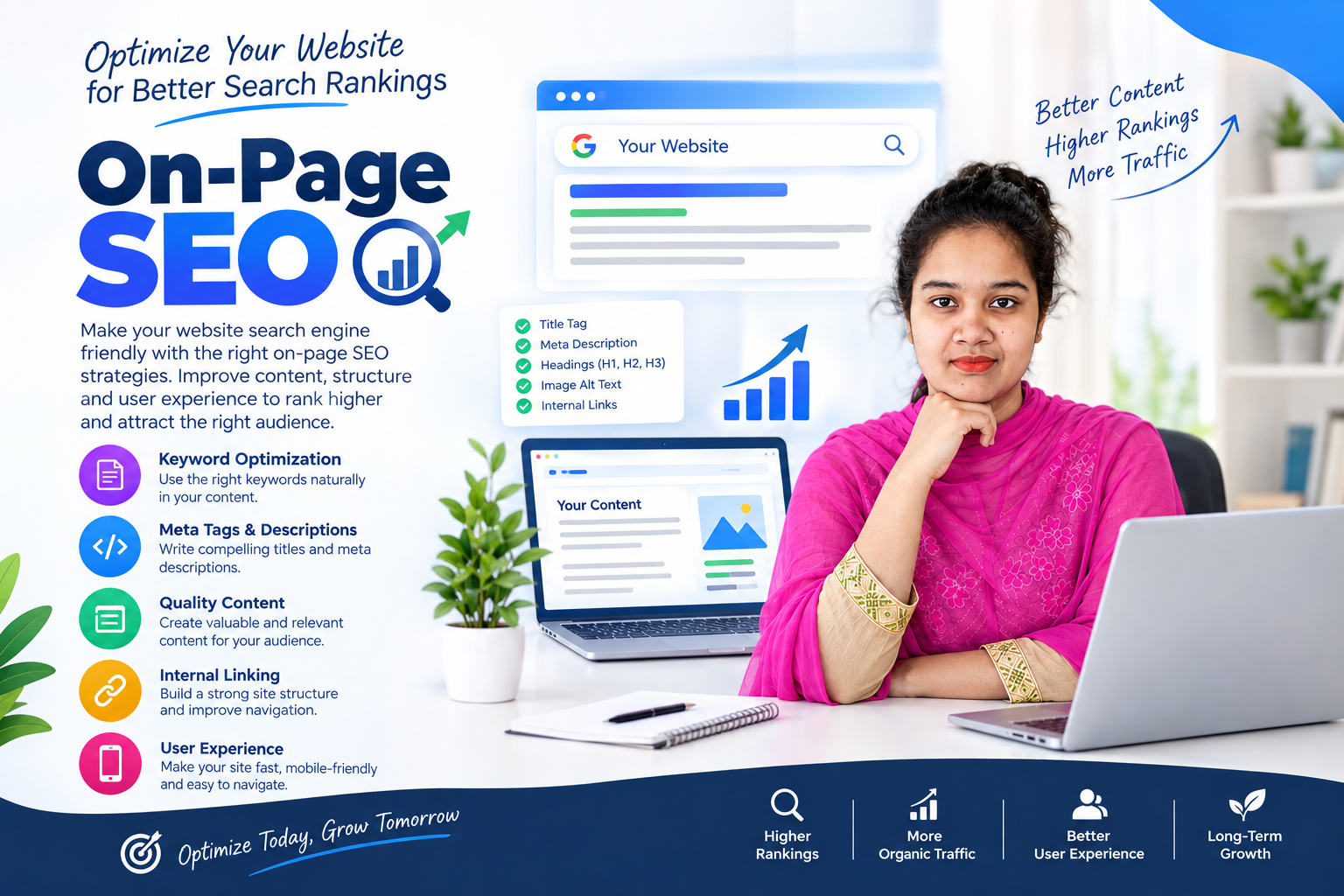
On Page SEO Optimization: My Approach as an SEO Expert in Bangladesh
When a business owner asks me why a website is not getting enough organic traffic, I rarely look at just one thing. SEO is not a magic button where adding a keyword suddenly sends a page to the top of Google. A successful website needs useful content, clear structure, relevant keywords, good user experience, and signals that help search engines understand what each page is actually about. This is exactly where on page SEO optimization becomes important.My name is Sumiya Fariha, and I am an SEO expert in Bangladesh specializing in on-page SEO. My approach is focused on making website pages useful for real people while also making them easier for search engines to understand. Google itself recommends creating helpful, reliable, people-first content and using the words people would naturally search for in important parts of a page.I don't believe effective SEO means repeating the same keyword again and again. Instead, I look at the complete page: its search intent, content quality, headings, title, meta description, internal links, images, URLs, and overall user experience. My goal with on-page SEO is simple: help the right people find the page they need and quickly see what it offers.
On page SEO optimization is the process of improving individual website pages so that both search engines and users can understand, navigate, and benefit from them more easily. It includes elements such as keyword targeting, title tags, headings, content, internal links, URLs, image optimization, and other page-level improvements.Think of your website as a physical store. If products are thrown randomly onto shelves, signs are unclear, and customers cannot find what they need, people will probably leave. Your website works much the same way. Search engines need clear signals about the subject of a page, while visitors need clear information that answers their questions.Google's SEO guidance explains that SEO helps search engines understand content and helps users discover a website through search. Google also recommends making content easy to read, well organized, unique, useful, and up to date.
Why On Page SEO Optimization Matters
A page can contain excellent information and still struggle if its structure is confusing. Imagine writing the perfect answer to a customer's question but placing it under an unclear title, using random headings, and failing to explain what the page offers. The information may be valuable, but the communication is weak.That's why I treat on page SEO optimization as both an SEO activity and a communication strategy. I want a visitor to understand the page quickly, and I want search engines to identify the topic and context without unnecessary confusion.
How Search Engines Understand a Page
Search engines examine many elements to understand a page. The title, headings, visible content, internal links, images, and other page information can all contribute to how the page is interpreted.Google can use different parts of a page to create title links in search results, including the title tag, main heading, other headings, prominent text, and page content. That’s why on-page SEO is about more than just adding keywords to your content.
As an SEO expert in Bangladesh, I approach every project according to the website's actual goals rather than applying the same checklist to every business. An e-commerce website, local service business, personal brand, and B2B company can have completely different search behavior and customer journeys.Before changing a page, I want to understand what the business offers, who the target audience is, what problems the audience has, and what action the visitor should take after reading the page. This background helps me create an optimization strategy that makes sense for the business.I also look at existing performance when data is available. Search Console information, rankings, impressions, clicks, existing content, competitors, and search intent can reveal opportunities that aren't obvious from the page alone. This makes my process more strategic than simply changing titles and adding keywords.
Understanding the Business Before Optimizing
One common SEO mistake is optimizing a page without first understanding what it needs to achieve. A keyword might have significant search volume, but if the people searching for it are not potential customers, ranking for it may not produce meaningful business results.For example, a professional SEO consultant may not need to target every broad SEO-related keyword. The better approach could be to create focused pages around services such as on page SEO optimization, technical SEO, keyword research, website audits, or local SEO depending on the business model.I therefore connect SEO decisions with business objectives. The goal isn't just more visitors. The goal is to bring in the right visitors who are more likely to engage, get in touch, request a service.
Keyword research is one of the foundations of my on page SEO optimization process. Before optimizing a page, I want to understand the language people use when searching for the information, product, or service represented by that page.However, modern keyword research should not be treated as a hunt for one magical phrase. Search engines can understand relationships between words and concepts, so a strong page can naturally address multiple related searches without awkward repetition. Google's SEO Starter Guide also notes that its language-matching systems can understand how a page relates to different queries without requiring every exact keyword variation to appear on the page.
Matching Keywords With Search Intent
Search intent is the reason behind a search. Someone searching for "what is on page SEO" probably wants an explanation, while someone searching for "on page SEO service Bangladesh" may be comparing service providers.These users have different needs. If I optimize a service page only around informational content, I may fail to address the commercial visitor. On the other hand, filling an informational article with aggressive sales messages can make the content feel unnatural.I therefore consider whether the intent is informational, commercial, navigational, or transactional before deciding how to structure the page.
Optimizing Titles and Meta Descriptions
Your title is often the first thing a searcher sees when deciding whether to click a result. Google describes title links as important because they give users a quick understanding of what a search result is about and why it may be relevant.For that reason,I write clear, descriptive titles that accurately reflect the page content instead of relying on vague . I also consider the primary keyword, user intent, business value, and readability.Meta descriptions are also useful because they can help communicate what a page offers in search results. Google may generate snippets automatically, but writing a useful description gives the page a strong starting point for communicating its value.
Creating Search-Friendly Page Titles
An effective title should be clear, concise, and accurately describe the content. It should tell users what they are likely to find after clicking.For example, instead of a generic title such as "SEO Services," a more descriptive service page might use something like On Page SEO Optimization Services for Better Search Visibility.The exact wording should depend on the page and audience. I don’t add keywords to titles just for the sake of including more of them. A title that looks unnatural can reduce clarity even if it appears technically optimized.
Content Optimization and E-E-A-T
Content is at the heart of my on page SEO optimization approach. I don’t create content just to please search engines. I optimize it so that visitors can actually use it.Google's guidance emphasizes helpful, reliable, people-first content and encourages creators to demonstrate experience and expertise. It also explains that E-E-A-T stands for Experience, Expertise, Authoritativeness, and Trustworthiness, with trust being especially important. Google also makes it clear that E-E-A-T isn’t a direct ranking factor.
Building Helpful and Trustworthy Content
The page should give visitors the answers they came looking for. It should provide enough context to help someone make a decision rather than forcing them to search again for basic information.I focus on originality, clarity, practical explanations, relevant examples, and accurate information. I also avoid unnecessary filler. A longer page isn't automatically better simply because it contains more words.Google explicitly states that there is no preferred word count that creators should target. The emphasis is on satisfying the reader rather than writing to an arbitrary length.
Heading Structure and On Page SEO Optimization
A good heading structure works like a roadmap. When visitors land on a page, headings help them scan the content and quickly find what they’re looking for. I use H1 for the main topic and H2, H3, and H4 headings to organize related sections in a clear, easy-to-follow way. I don't add headings merely to insert keywords. Each heading should introduce a meaningful section.For this article, on page SEO optimization is incorporated into several levels of the heading structure while keeping the headings readable and relevant.
Internal Linking and User Experience
Internal linking is also an important part of my on-page SEO process. I want the website to feel connected, not like a bunch of separate pages. Related pages should work together as a useful information network.For example, an SEO service page might naturally link to related pages about keyword research, technical SEO, website audits, local SEO, or SEO content strategy. These links help visitors find related information and make it easier for search engines to understand how pages connect. Google also recommends a clear site structure, useful headings, relevant internal links, and descriptive anchor text to help sitelinks work effectively.
Images, URLs, and Technical On-Page Elements
On-page SEO also covers more than just the written content on a page. Images, URLs, links, page structure, and accessibility-related details can all influence how clearly a page communicates its purpose.Image filenames and alt text should describe images appropriately instead of being stuffed with keywords. URLs should be readable and relevant. Navigation should be logical, and important content should be accessible to search engines.Google's Search Essentials recommends using words people would use to find content in prominent locations such as titles and main headings, as well as descriptive locations such as alt text and link text.
My On Page SEO Optimization Process
I start by understanding the page and finish by tracking how well it performs. I don't believe SEO should be treated as a one-time task because websites, competitors, search behavior, and content can change over time.First, I audit the existing page. Then I identify opportunities involving keywords, intent, content, headings, metadata, internal links, images, and page structure. After implementation, I monitor performance and make improvements based on available data.
Audit, Optimize, Monitor, and Improve
My basic workflow can be summarized as:
1.Understand the business and target audience.
2.Analyze keywords and search intent
3Audit the existing page.
4.Optimize titles, headings, content, and metadata.
5.Improve internal linking and page structure.
6.Optimize images and other on-page elements.
7.Monitor results and refine the strategy.
This process allows me to treat on page SEO optimization as an ongoing growth activity rather than a checklist that ends after publishing.
Common On-Page SEO Mistakes to Avoid
One of the most common mistakes I see is trying too hard to optimize. Website owners sometimes believe that repeating a keyword dozens of times will make Google understand the topic better. In reality, excessive repetition can make content uncomfortable to read and can distract from the user's actual needs.
Why My On-Page SEO Services?
As an SEO expert in Bangladesh, I focus on practical and personalized SEO strategies rather than applying the same template to every website. My on-page SEO service is designed to improve the way individual pages communicate with both search engines and potential customers.I pay attention to the details that can easily be overlooked: search intent, keyword placement, content quality, heading hierarchy, title tags, meta descriptions, internal linking, image optimization, and overall page usability.My philosophy is simple: SEO should support business growth, not just rankings. A page ranking for an irrelevant keyword isn't a meaningful success if it doesn't attract the right audience. I want my optimization work to help businesses build pages that are useful, credible, understandable, and capable of attracting relevant organic traffic over time.
On-page SEO is about much more than just adding keywords to a page. It is the process of making a page clearer, more useful, more relevant, and easier for both people and search engines to understand.As an SEO expert in Bangladesh, I approach on-page SEO by combining keyword research, search intent, content optimization, E-E-A-T principles, headings, metadata, internal linking, image optimization, and user experience. I believe the strongest SEO strategy starts with the visitor and then uses optimization to help search engines understand the value that visitor is receiving.Google's current guidance consistently emphasizes helpful, reliable, people-first content rather than search-engine-first writing.If your website has good services or products but isn't communicating them effectively through search, improving your on-page SEO can be an important step. A well-planned on-page SEO strategy helps each page stay focused, cover its topic clearly, and reach the people it’s meant for.