
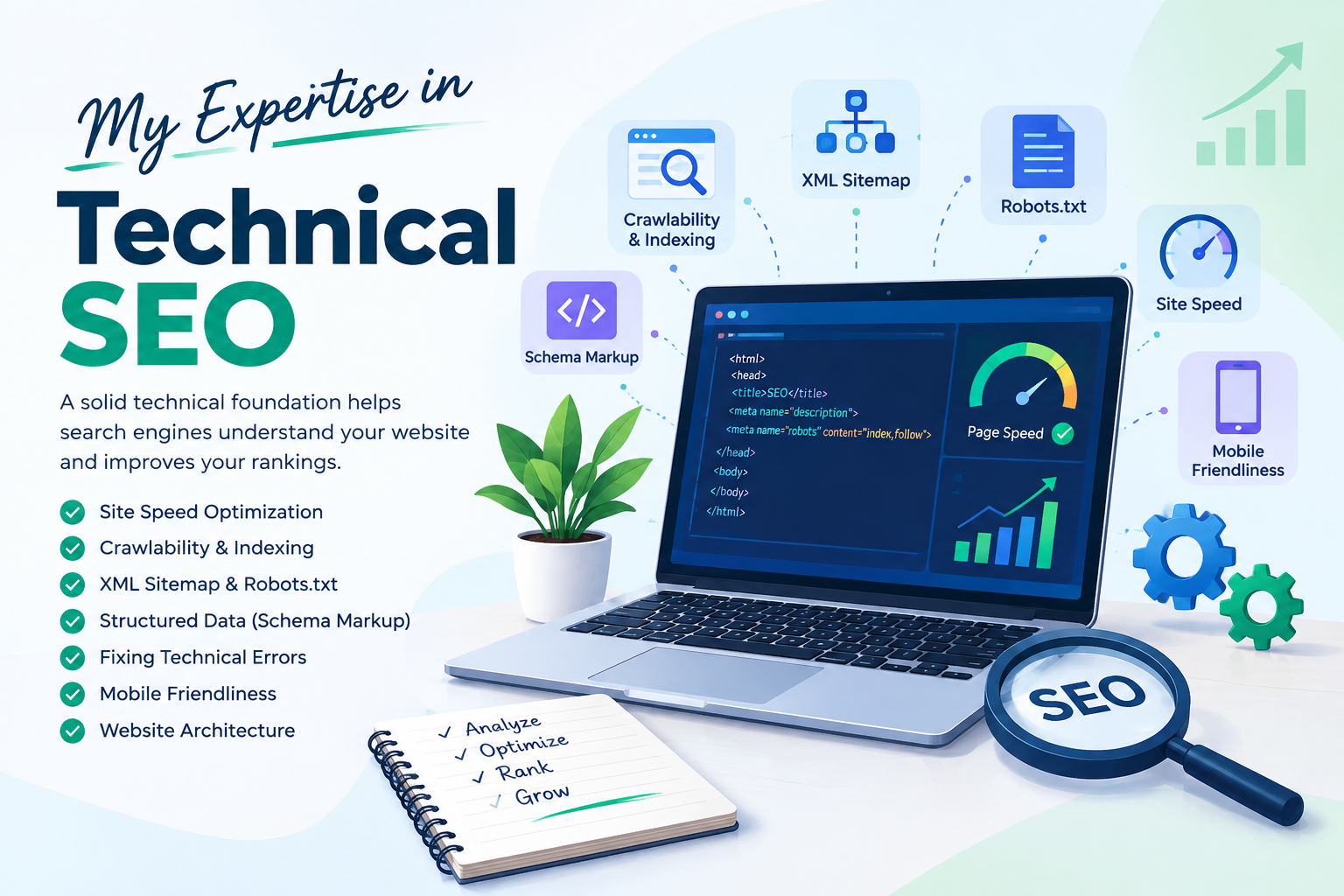
My Technical SEO Expertise: How I Build Stronger, Search-Ready Websites
A website can have excellent content, beautiful design, and strong backlinks, yet still struggle to perform in search results if its technical foundation is weak. That is where my technical SEO expertise comes into play. My approach to technical SEO is focused on making websites easier for search engines to crawl, understand, render, and index while also creating a smoother experience for real visitors. As an SEO expert in Bangladesh, I understand that businesses need more than a collection of SEO tactics; they need a website that can support sustainable visibility and growth. Google continues to provide guidance around crawling, indexing, structured data, search appearance, and technical accessibility through Google Search Central, which makes keeping technical SEO practices current especially important.
When I talk about my technical SEO expertise, I am not simply talking about fixing a few broken links or adding an XML sitemap. Technical SEO is much broader. It is the process of improving the technical elements of a website so search engines can efficiently discover pages, understand their relationships, process their content, and determine which URLs should appear in search. I look at the website as a complete system rather than treating individual errors as isolated problems. This matters because a technical issue on one part of a site can sometimes affect other areas, just like a small crack in a building's foundation can eventually create problems throughout the structure. My goal is therefore to identify the real cause of an SEO problem instead of applying temporary fixes that only make a report look cleaner.
Why Technical SEO Is the Foundation of Search Visibility
Search engines need access to a website before they can properly evaluate its content. Google explains that Googlebot crawls websites to discover relevant content, while technical signals and accessibility affect how that content can be processed. That means even the most carefully researched keyword strategy can lose effectiveness when important pages cannot be crawled or indexed correctly. During technical SEO work, I pay close attention to crawlability, indexability, website architecture, URL structures, redirects, canonicalization, mobile usability, performance, and other technical signals. I also check the available data to tell real issues apart from warnings that may not need immediate attention.This practical distinction is important because SEO is not about fixing every notification simply because a tool produces it; it is about prioritizing issues according to their potential impact on visibility, users, and business goals.
My technical SEO expertise starts with understanding the fundamentals before moving into complicated recommendations. I first want to know how the website is structured, which pages matter most, how users move through the site, and how search engines can discover those pages. From there, I can identify technical weaknesses that may prevent important content from receiving the attention it deserves. I also consider the website's platform, business model, size, and current SEO maturity because a technical strategy that works for a small service website may not be appropriate for a large ecommerce site. My philosophy is simple: fix the foundation first, then build on it. A technically healthy website gives content, links, and other SEO efforts a much stronger environment in which to perform.
How I Audit a Website Before Making Technical SEO Changes
A technical SEO audit should be more than a long spreadsheet filled with warnings. I approach an audit as a diagnostic process where each issue needs context. I examine how the website is currently performing, which pages receive organic traffic, whether important URLs are indexed, how the site's navigation works, and whether there are obvious barriers between search engines and valuable content. I also compare the website's technical structure with its actual business priorities. For example, a service business may need its main service and location pages prioritized, while an ecommerce site may need much closer attention to product URLs, filters, pagination, variants, and duplicate content. This approach helps me turn technical data into an actionable SEO roadmap instead of overwhelming a business owner with dozens of disconnected recommendations.
Crawling and indexing are two areas I investigate carefully because a page generally needs to be accessible and indexable before it can compete effectively in organic search. I check for accidental noindex directives, blocked resources, problematic robots.txt rules, redirect chains, server errors, orphan pages, inconsistent canonical signals, and other barriers that can interfere with search engine discovery. Google provides tools such as Search Console and URL Inspection to help website owners understand how Google sees individual URLs. I use this type of evidence to distinguish between pages that are genuinely missing from search and pages that simply have not been crawled or processed yet. Instead of assuming that every indexing problem has the same cause, I investigate the underlying reason and recommend the most appropriate solution.
A logical website architecture helps both users and search engines understand how pages relate to one another. During an audit, I examine whether important pages are too many clicks away from the homepage, whether navigation is confusing, whether internal links support key pages, and whether there are orphaned URLs that receive little or no internal linking support. Internal linking isn’t about adding as many links as you can. The links should make sense within the site's information architecture and help visitors move naturally from one relevant topic to another. I also look for opportunities to strengthen topical relationships between related service pages, blog posts, categories, and supporting resources. A well-structured internal linking system can make a website feel less like a pile of individual pages and more like a connected library where every important resource has a clear place.
My Technical SEO Expertise in Crawlability and Indexing
One of my key areas of technical SEO expertise is helping search engines crawl and understand websites more easily. I work with technical elements such as robots.txt, XML sitemaps, canonical signals, internal links, redirects, status codes, and indexability directives. These elements may seem invisible to ordinary website visitors, but they can have a major role in how search engines discover and interpret a site. Google states that crawling infrastructure is used to discover web content across its products, making crawl management an important part of maintaining a technically accessible website. I therefore focus on making the site's crawl paths logical and reducing unnecessary technical obstacles. The objective is not to force search engines to crawl everything; it is to help them efficiently discover and process the pages that actually matter.
I treat robots.txt and XML sitemaps as communication tools rather than magic ranking tools. A sitemap can help search engines discover important URLs, while robots.txt can provide crawling instructions for areas that should not be crawled. However, these files need to be configured carefully because blocking a URL from crawling does not automatically mean the URL will never appear in search, and sitemap inclusion does not guarantee indexing. I also check whether the sitemap contains useful, canonical URLs rather than outdated, redirected, duplicate, or intentionally excluded pages. Google recommends submitting sitemaps and provides Search Console resources for monitoring search visibility and indexing. My role is to make these systems work together instead of treating them as separate checkboxes on an SEO audit.
How I Handle Technical On-Page SEO Issues
Technical on-page SEO sits at the intersection of content and website infrastructure. I examine title elements, headings, canonical URLs, duplicate versions of pages, metadata, internal linking, image handling, and other page-level signals while keeping the search intent of each page in mind. A well-optimized page should be easy for Google to access and clearly explain what it’s all about. When technical and content signals conflict, search engines may have a harder time understanding the preferred version or purpose of a URL. That is why my technical SEO work often works alongside on-page optimization. I want the technical structure to support the content strategy rather than operating as a completely separate activity.
Canonicalization and redirects are especially important on websites where multiple URLs can represent similar or identical content. I check whether canonical tags point to appropriate URLs, whether redirects lead users to relevant destinations, and whether chains or loops are creating unnecessary complications. I also review HTTP status codes because a website should communicate clearly whether a page exists, has moved, or cannot be served. Google specifically provides technical documentation covering crawling, HTTP status codes, canonicalization, and related search infrastructure. My approach is to preserve useful URLs where possible and consolidate signals when multiple versions of similar content exist. Instead of changing URLs casually, I consider their existing traffic, backlinks, internal links, indexing status, and business value before recommending a change.
My Technical SEO Expertise in Website Performance
Website performance is another important part of my technical SEO expertise because technical optimization should ultimately serve people, not just search crawlers. Slow pages, unstable layouts, and frustrating interactions can make a website harder to use, particularly on mobile devices and slower connections. I check performance data to find ways to improve image loading, reduce unnecessary scripts, optimize page size, improve caching and rendering, and make resources load more efficiently. Google has clarified its Core Web Vitals guidance over time, including the role of Interaction to Next Paint as a Core Web Vital. I do not treat performance scores as a simple game where a perfect number automatically means better rankings. Instead, I use performance data to understand where users may be experiencing friction and where technical improvements can create a better overall website.
Mobile optimization is especially important because many people now interact with websites through smartphones. During technical SEO work, I consider responsive design, viewport configuration, loading behavior, interactive responsiveness, layout stability, and the overall mobile experience. I also look beyond a single laboratory score because real-world performance can vary according to devices, networks, geographic locations, and user behavior. A website that looks fast on a powerful desktop computer may feel completely different on a lower-powered mobile device. My goal is to identify meaningful performance improvements rather than making cosmetic changes simply to improve a testing score. When performance improvements also make navigation easier, pages faster, and interactions smoother, the SEO work becomes valuable beyond search engines.
Structured data is another area where technical implementation can support search understanding and appearance. Google describes structured data as a standardized format that helps it understand page content and provides documentation for supported search features. When appropriate, I review whether relevant structured data can accurately describe an organization's content, products, articles, profiles, breadcrumbs, or other eligible information. I also pay attention to validation because incorrect or misleading markup can create problems instead of benefits. Google recommends validating structured data and using tools such as the Rich Results Test and URL Inspection when appropriate. I never treat schema markup as a guarantee of rich results; Google's documentation makes clear that eligibility does not guarantee that a particular search feature will appear.
Modern websites increasingly rely on JavaScript, and this creates another technical area that requires careful investigation. JavaScript can power menus, filters, interactive elements, ecommerce features, and dynamically loaded content, but implementation choices can affect how content is rendered and discovered. Google has continued updating its technical documentation around JavaScript and crawling, including clarifications about how Google processes JavaScript in different circumstances. When auditing JavaScript-heavy websites, I want to know whether important content, links, metadata, and structured information are available in the rendered page in a way that search engines can process. I also look for unnecessary client-side complexity that may create performance or crawl-related challenges. The objective is not to avoid JavaScript; it is to ensure that technology supports search accessibility rather than unintentionally hiding valuable information.
Website security is another foundational consideration in my technical SEO work. HTTPS protects data exchanged between users and websites and has become a standard expectation for modern sites. During a technical review, I can examine issues such as insecure resources, certificate problems, mixed content, unwanted redirects, and inconsistent HTTP and HTTPS versions. Security issues can create trust problems for users even before SEO is considered, so I view technical security as part of the broader website quality picture. A business website should make visitors feel comfortable interacting with it, completing forms, browsing products, or requesting services. Technical SEO should make it easier for search engines to access your website while providing visitors with a smooth and reliable experience.
My Process for Solving Technical SEO Problems
My technical SEO process generally begins with discovery, followed by auditing, prioritization, implementation, validation, and monitoring. I start by understanding the website and its business objectives because technical recommendations should support a real goal. Next, I collect evidence from crawling tools, Search Console, analytics, page-level inspection, performance information, and manual review where appropriate. I then prioritize problems according to severity, potential SEO impact, implementation difficulty, and business importance. After fixes are implemented, I validate them instead of assuming that the work succeeded simply because a task was marked complete. Google advises giving search engines time to recrawl and reindex updated pages, showing that technical SEO requires ongoing effort rather than delivering instant results.
Why I Focus on Sustainable Technical SEO Growth
What makes my technical SEO expertise different is my focus on sustainable improvement rather than quick technical tricks. I do not believe SEO success should depend on constantly chasing minor algorithm rumors or blindly following automated audit scores. A stronger approach is to build a technically accessible website, create useful content, organize information logically, monitor search performance, and continue improving when evidence shows that something needs attention. Google itself maintains regularly updated Search Central documentation, with technical guidance continuing to evolve throughout 2026. As an SEO expert in Bangladesh, I want my technical SEO services to be practical for businesses that need measurable progress without unnecessary complexity. Whether the website is a small business site, personal brand, service website, blog, or growing online business, my goal is to create a stronger technical foundation that supports long-term organic growth.
My approach to technical SEO is simple: a website should be easy for both visitors and search engines to understand. From crawling and indexing to website architecture, redirects, canonicalization, performance, structured data, JavaScript, security, and mobile usability, technical SEO connects many parts of a website that are easy to overlook. I approach each project by investigating the real problems, prioritizing meaningful fixes, validating changes, and monitoring the results over time. Technical SEO is not a one-time checklist because websites change, search systems evolve, and businesses grow. That is why I focus on building a reliable technical foundation that can continue supporting content, visibility, user experience, and organic growth.